Every year, thousands of UAE students send off university applications with strong grades and a list of activities and still do not get into the programs they want. The reason is almost always the same. Good grades get your application read. They do not get you accepted. What gets you accepted is a clear, honest picture of who you are, what you care about, and what you have actually done with your time outside a classroom. Here is how to build that picture and when to start.
What Do Competitive Universities Actually Look For?
| Factor | Why It Matters | How Universities See It |
|---|---|---|
| Academic Results | Still, the baseline without competitive grades, other factors rarely matter | GPA, predicted grades, IB/AS Level scores, class rank |
| Extracurricular Activities | 90% of competitive universities consider this very important in admissions decisions. | Depth of involvement, leadership, consistency over time |
| Personal Statement Essay | The only place where you tell your story in your own voice | Writing quality, self-awareness, genuine reflection |
| Recommendation Letters | Third-party evidence of who you are as a person and student | Specific, detailed examples from teachers who know you well |
| Leadership and Impact | Universities want students who contribute, not just participate. | Outcomes achieved, teams led, communities served |
| Skills and Growth | Shows the ability to learn and develop a predictor of university success | Progression over time, not just a one-off certificate |
| Career Direction | Admissions offices prefer students who know why they want the course. | Alignment between activities, essays, and chosen degree |
Dr. Mauli Mahajan, founder of MyCompassToday and 3E Worldwide, who spoke at the Gulf News Edufair in Dubai on October 2, 2026, put it plainly: marks are important, but students need to tell their story through their application to get accepted. The strongest profile is not the one with the most certificates. It is the one that sounds like you.
The 8 Pillars of Profile Building Every UAE Student Needs
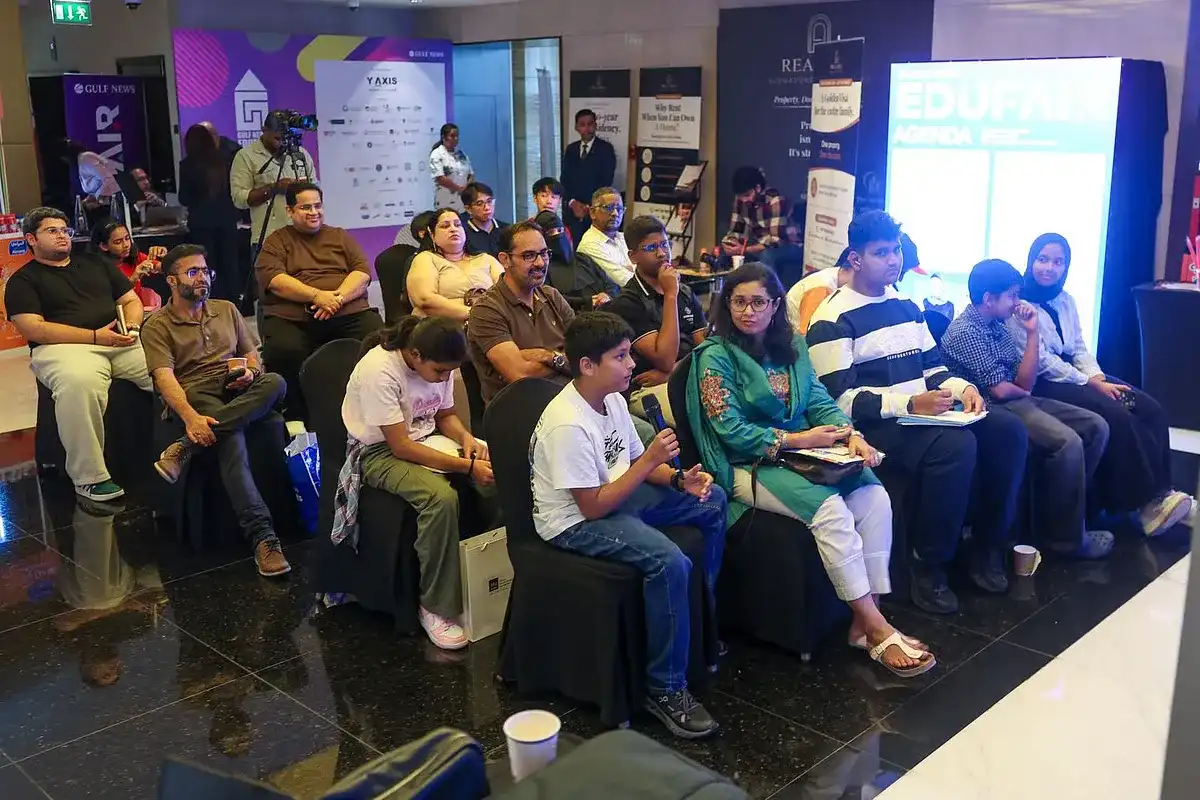
Building a profile is not about doing as many things as possible before Grade 12. It is about doing the right things, consistently, with enough depth that you can actually talk about them in an interview or write about them in a personal statement. Dr. Mahajan outlined eight areas that help students develop a genuine, multi-dimensional profile over time.
| # | Pillar | What It Means | Practical Examples for UAE Students |
|---|---|---|---|
| 1 | Explore | Try new things deliberately, not to add them to a list but to find out what you genuinely care about | Attend a robotics workshop, try a new language, shadow a professional in a field you are curious about, and visit a museum or cultural center outside school |
| 2 | Create | Building or making something of your own shows initiative, original thinking, and the ability to follow through | Start a student newsletter, build a website or app, write and publish an article, produce a short film, design a product for a school competition |
| 3 | Experience | Step outside the classroom through internships, research, job shadowing, or structured programs. | Apply for a university research program in the UAE, intern at a company during summer, participate in a Model United Nations conference, and join a journalism program. |
| 4 | Lead | Take responsibility for outcomes; this does not always mean being a president or captain; it means taking ownership of something | Organize a school event, lead a club committee, manage a volunteer project, mentor a younger student, and coordinate a fundraiser |
| 5 | Serve | Contribute to a community or cause beyond your own interests—universities want to see genuine care and impact. | Volunteer at a food bank, teach basic skills to elderly residents, participate in UAE National Day community events, support a local charity or animal shelter |
| 6 | Compete | Test your abilities against others—competitions push you to perform at a higher level and generate results you can point to. | Enter a Science Olympiad, join a debate tournament, participate in a coding hackathon, and compete in national or regional academic challenges |
| 7 | Develop a Skill | Go deep on one specific skill over an extended period—not just a weekend workshop but something you have genuinely worked at. | Learn to code seriously using a structured online course, reach a high grade in a music exam, earn an advanced photography certificate, become proficient in a second or third language |
| 8 | Reflect | Think and write about what you have learned from your experiences—this turns activity into genuine learning and learning into a story. | Keep a regular journal, write short reflections after events or projects, discuss your experiences with a mentor, develop a portfolio that tracks your growth over time |
UAE students who want to study in Dubai after completing their secondary education have a wide range of options to explore. Take a look at the full list of Universities In Dubai to find degree programs, campuses, and tuition fees for universities across the emirate.
When to Start Building Your Profile Grade by Grade
One of the most common mistakes UAE students and families make is waiting until Grade 11 or 12 to think about profile building. By that point, the window for building genuine, sustained experiences is almost closed. Here is a realistic timeline for when to do what.
| Grade | Focus Area | What to Do This Year |
|---|---|---|
| Grade 7–8 | Explore broadly. | Try different activities—sports, arts, science, and community. Do not specialize yet. Pay attention to what you actually enjoy versus what your parents suggest. |
| Grade 9 | Start going deeper. | Drop activities that do not interest you. Commit to two or three things you genuinely care about. Start looking at competitive opportunities and research programs for students your age. |
| Grade 10 | Build experience and lead. | Apply for an internship or research program. Take on a leadership role in one activity. Start a project of your own. Attend university information events and fairs. |
| Grade 11 | Demonstrate impact and focus. | Your profile should be taking shape. Your activities should connect to each other and to what you want to study. Begin planning your personal statement. Think about which teachers will write your strongest recommendation letters. |
| Grade 12 | Apply and present your story. | Focus on applications, essays, and interviews. Your profile is already built. This year is about presenting it clearly, not adding to it at the last minute. |
Students in Abu Dhabi who are weighing their options for local higher education can explore the full directory of programs, fees, and locations at Universities In Abu Dhabi to help plan their next steps.
How to Write a Personal Statement That Actually Works
The personal statement is the one part of a university application that is entirely yours. Admissions officers read hundreds of essays every week. They can immediately tell the difference between an essay that was written by the student and one that was edited beyond recognition by a parent or consultant. Here is what separates the essays that get remembered from the ones that get forgotten.
| Common Mistake | What to Do Instead |
|---|---|
| Listing every activity you have ever done | Choose two or three experiences and go deep—explain what you did, what you learned, and how it changed how you think. |
| Opening with a grand statement about your passion for medicine or law | Open with a specific moment, situation, or question that genuinely sparked your interest—the more specific and real, the better. |
| Describing what an activity is rather than what you got from it | Focus on growth, not description—tell the reader what you discovered about yourself through the experience. |
| Using overly formal or elaborate language that does not sound like you | Write in a voice that is clearly yours—clear, confident, honest sentences work better than complex vocabulary. |
| Ending with a generic sentence about your excitement for university | End with something that leaves the reader with a clear sense of where you are going and why this course is the logical next step for you. |
| Writing the essay the night before the deadline | Draft, walk away for a few days, revise, show to a trusted teacher or mentor, revise again—great essays take weeks, not hours. |
Students in Sharjah considering local universities or campus options nearby can browse the complete list of Universities In Sharjah for degree programs, admission requirements, and campus details.
How Parents Can Help Without Making Things Worse
Dr. Mahajan specifically addressed parents at the Edufair session, pointing out that parental involvement can either significantly help or significantly hurt a student’s profile-building process. The line between support and pressure is easy to cross without realising it.
| Helpful Parent Behavior | Harmful Parent Behavior |
|---|---|
| Ask your child what they enjoy, and listen to the answer without redirecting it toward a career you prefer. | Signing them up for activities based on what looks impressive rather than what interests them |
| Help with logistics—transport, registration fees, and scheduling — without taking over decision-making. | Writing or significantly editing their personal statement, essays, or self-evaluation documents |
| Connect them with people in your professional network who work in fields they are curious about. | Comparing them to other students, especially siblings, cousins, or children of colleagues |
| Stay up to date with school communications and help manage their time without micromanaging their schedule. | Contacting the school or university on their behalf for things they should be handling themselves |
| Celebrate effort and growth, not just results—a student who took on a challenge and failed still learned something valuable. | Attaching conditional praise to outcomes—this creates anxiety and teaches children to hide their struggles |
| Encourage regular reflection—ask what they learned from an experience, not just whether they enjoyed it or won | Making all decisions about extracurriculars causes the student to lose ownership of their own profile |
Students in Ajman can explore higher education options close to home through the full directory of Universities In Ajman covering available degree programs and campus information. For students in Al Ain, the guide to Universities In Al Ain covers all the available higher education options in the garden city. Students based in Fujairah can find all local university options and course information through Universities In Fujairah.
What Universities in the UAE and Abroad Are Actually Saying
The shift Dr. Mahajan described at the Edufair is not a new trend—it has been building for years across US, UK, Canadian, Australian, and European universities. What has changed is the pace of that shift and how explicitly competitive universities are now saying it. Here is what the admissions landscape actually looks like for UAE students applying abroad.
| Destination | What Matters Most | Common UAE Student Mistake | Edge UAE Students Often Have |
|---|---|---|---|
| United States | Holistic review—grades, test scores, essays, activities, and recommendation letters weighted together | Only submitting SAT/ACT scores without strong extracurriculars | Cultural diversity, multilingualism, international experience |
| United Kingdom | Strong academic focus with a detailed personal statement—one essay, no supplements | Personal statement that reads like a CV rather than a story | IB and A-Level familiarity, often very strong academic preparation |
| Canada | Mix of grades, activities, and school reference letters—less essay-heavy than the US | Not researching province-specific requirements—Ontario schools differ from British Columbia | Strong community service records from UAE schools |
| Australia | Primarily academic—ATAR equivalent or IB score—but universities are increasingly adding personal statements. | Underestimating the importance of English proficiency evidence | IELTS scores tend to be strong from UAE schools. |
| UAE Local Universities | Grades, interview, and sometimes portfolio depending on the program | Not preparing for the interview stage with the same seriousness as the academic application | Already within the local network and employer connections |
Students in Ras Al Khaimah considering universities locally or researching options closer to home can find a full listing of available institutions through Universities In Ras Al Khaimah covering campuses and degree programs in the emirate.
The One Thing That Separates Good Applications From Great Ones
Depth. Not breadth. A student who spent three years building one thing—a community garden, a student newspaper, a coding side project, or a peer tutoring program—and can speak intelligently and passionately about what they learned from it will always outperform a student who collected eight certificates from eight weekend workshops and cannot tell you what any of them actually changed about them.
Universities are trying to answer one question when they read an application: will this person contribute something meaningful to our campus community? The way you answer that question is not with a long list of activities. It is with a clear, honest story about who you are, what you care about, and how you have shown it through your actions over time. Start now. Do not wait for Grade 12 to start thinking about the story you want to tell. For more UAE education guides and helpful information for students and parents, visit Ever List.