Registering a company in Dubai gives entrepreneurs access to a major global trading hub, modern infrastructure, a stable business environment, and markets across the Middle East, Africa, Europe, and Asia. But getting a trade licence is only one part of the process. You also need to choose the right jurisdiction, business activity, legal structure, visa plan, office setup, and compliance framework before you apply.
This guide walks you through how to register a company in Dubai from start to finish. It covers mainland and free zone registration, required documents, costs, licences, visas, banking, corporate tax, VAT, and the mistakes that can delay your launch or add unnecessary costs.
Several authorities regulate Dubai company formation, including Dubai’s Department of Economy and Tourism (DET), the Invest in Dubai platform, and free zone authorities such as DMCC, IFZA, Dubai Silicon Oasis, Jebel Ali Free Zone (JAFZA), and Dubai Airport Free Zone. The right route depends on what your business sells, where you plan to trade, and how many visas you need.

Dubai Company Registration Overview: What You Need to Know First
Dubai is one of the UAE’s busiest business centres. It is home to mainland companies, specialist free zones, logistics operations, professional service firms, technology start-ups, retailers, restaurants, property businesses, and international holding companies. Most businesses are set up as mainland entities or free zone companies. In more limited cases, an offshore or special-purpose vehicle may be suitable.
The UAE allows 100% foreign ownership for many mainland activities and most free zone companies. But ownership rules, approval requirements, and licence conditions still depend on the activity. Banking, insurance, legal services, education, healthcare, telecommunications, aviation, and some transport activities may need approval from the relevant government authority.
Tax planning should start during company registration, not after it. UAE corporate tax is generally 9% on taxable income above AED 375,000, subject to applicable legislation, exemptions, and qualifying free zone income rules. VAT is charged at 5%. Mandatory VAT registration generally applies when taxable supplies and imports exceed AED 375,000 over 12 months, or are expected to exceed that amount within 30 days.

Choose the Right Dubai Business Jurisdiction
Your first big decision is where to register the company. This affects where you can trade, which authority issues your licence, office requirements, visa eligibility, customs treatment, annual renewal fees, and how straightforward corporate bank account opening may be.
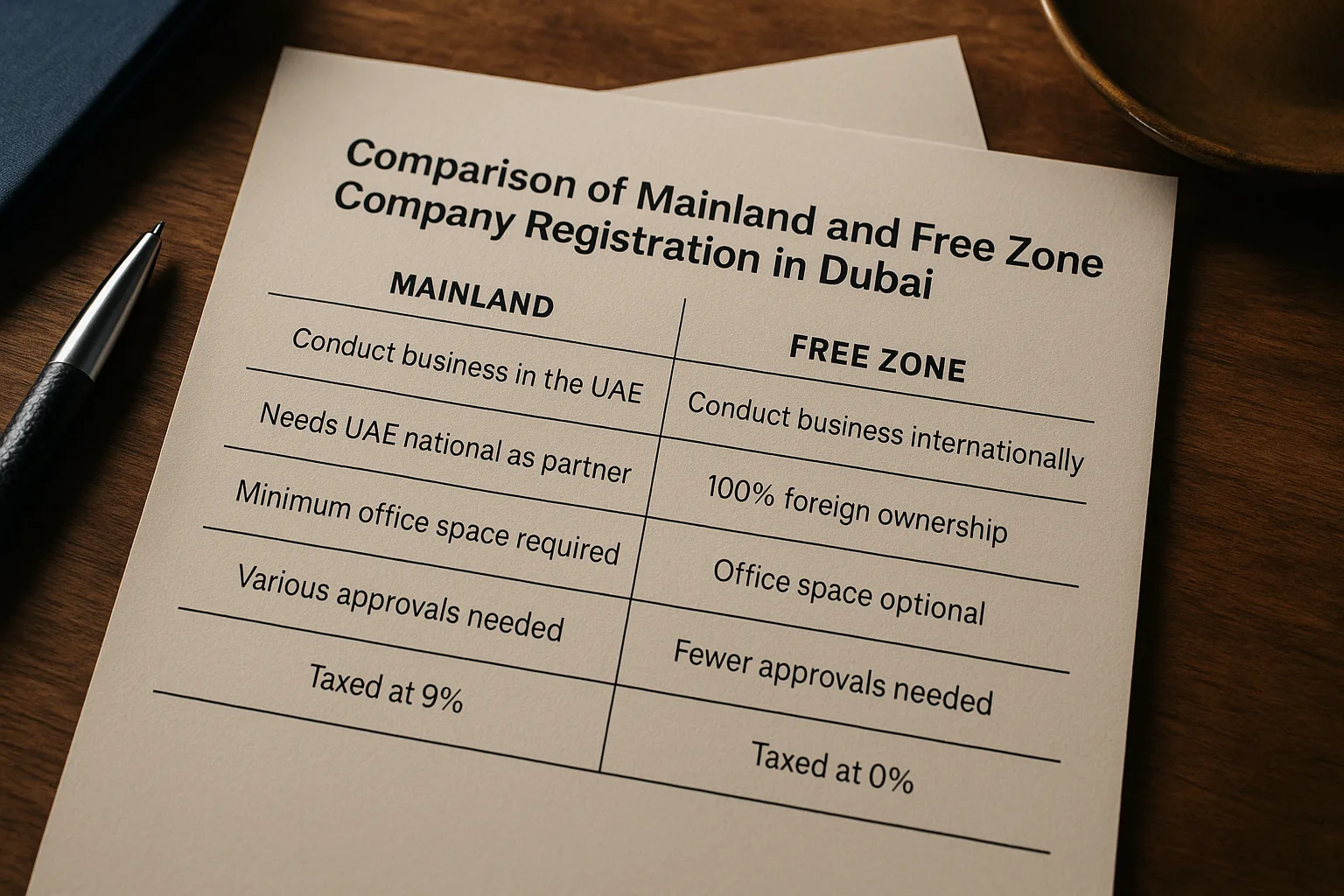
For most new businesses, the decision comes down to a Dubai mainland company or a Dubai free zone company. There is no single best option. A consultant working with overseas clients may prefer a lower-cost free zone structure. But a restaurant, local retailer, construction contractor, or business bidding for UAE contracts will often need a mainland licence.
Dubai Mainland Company
A mainland company is licensed by Dubai’s Department of Economy and Tourism, usually through the Invest in Dubai platform and related service channels. Mainland businesses can generally operate across Dubai and the wider UAE, as long as they stay within their licensed activity and meet any permit requirements.
- Suitable for businesses selling directly in the UAE market.
- Often required for shops, restaurants, salons, local service providers, and government contracting.
- Can lease office space in Dubai, subject to tenancy and Ejari requirements where applicable.
- May offer greater flexibility for hiring and visa allocations, depending on office size and immigration rules.
- Can require additional approvals for regulated business activities.
Dubai Free Zone Company
A free zone company is registered in a designated economic zone with its own licensing authority. Dubai has more than 20 free zones, each with different industry focuses, packages, rules, office options, and visa capacity. Examples include DMCC for commodities and professional services, DIFC for financial services, Dubai Internet City for technology, JAFZA for logistics and trade, and Dubai Media City for media businesses.
- Commonly used for consulting, e-commerce, digital services, trading, technology, and holding structures.
- Can offer flexi-desk, co-working, or serviced-office options.
- May offer simpler setup packages for founders who do not need several visas at the start.
- Generally allows 100% foreign ownership, subject to the free zone’s regulations.
- May face restrictions or need extra structuring when selling goods or services directly into the UAE mainland.
Mainland vs Free Zone: Quick Comparison
| Factor | Dubai Mainland | Dubai Free Zone |
|---|---|---|
| Licensing authority | Dubai DET / Invest in Dubai | Individual free zone authority |
| Direct UAE market access | Generally permitted within licence scope | May require a mainland distributor, branch, permit, or other structure |
| Office options | Usually requires a registered physical address | Flexi-desk, shared office, and physical office options may be available |
| Visa capacity | Usually linked to office space and immigration approval | Depends on the selected package and leased facility |
| Best for | Local trading, retail, hospitality, contracting, UAE services | International services, trading, digital firms, start-ups, specialist sectors |
Select the Correct Business Activity and Legal Structure
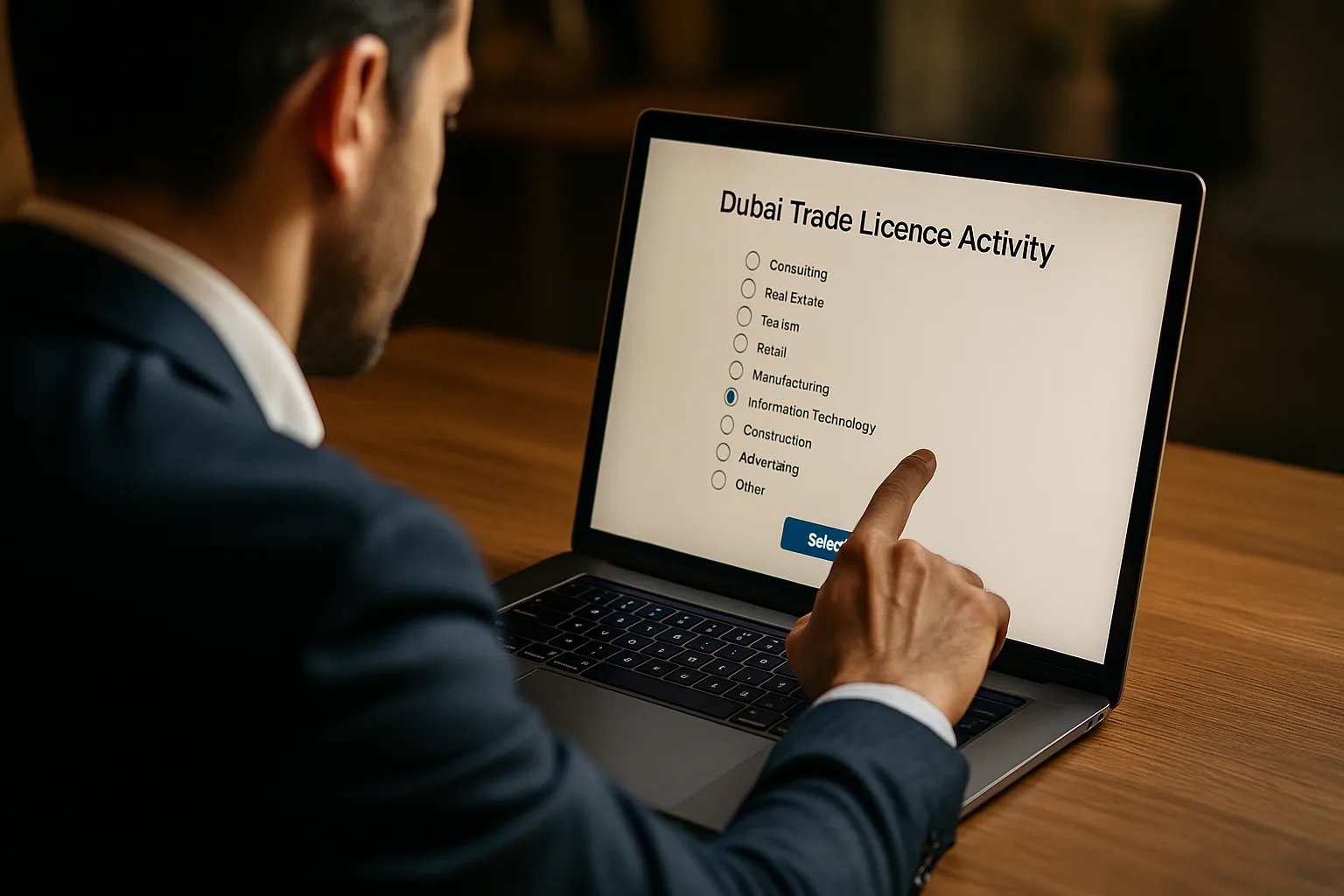
Your trade licence activity is more than an administrative formality. It determines which authority regulates your company, whether you need outside approvals, the type of licence you receive, and what you can legally invoice customers for. A vague or incorrect activity can create issues when opening a bank account, applying for visas, negotiating contracts, or renewing the licence.
Dubai licences are often classified as commercial, professional, industrial, tourism, or e-commerce-related licences, although categories vary between mainland and free zone authorities. A company selling physical products may need a commercial or trading licence. A marketing consultancy may need a professional services activity. Manufacturing, food handling, healthcare, education, and financial services can require separate sector approvals.
Common Legal Structures in Dubai
- Limited Liability Company (LLC): A common structure for mainland and free zone operating businesses. Liability is generally limited to the company’s capital, subject to legal obligations and personal guarantees.
- Free Zone Company (FZCO/FZ-LLC): A limited-liability entity registered within a free zone, often available for one or more shareholders.
- Free Zone Establishment (FZE): Often used where there is a single shareholder, depending on the free zone’s terminology.
- Branch of a foreign company: Lets an existing overseas company establish a Dubai presence without creating a separate subsidiary in some cases.
- Sole establishment: Often used by individual professionals for approved service activities, although you should assess liability and eligibility carefully.
How to Choose an Activity Properly
Start with how the company will actually make money. List what you will sell, who will pay you, where your customers are based, whether you will import goods, and whether you plan to hire staff. For example, “general trading” is different from “e-commerce retail,” while “management consultancy” is not the same as “marketing services” or “software development.”
If you plan to sell food, cosmetics, medical devices, supplements, educational services, financial products, or real estate services, check approval requirements before paying for a licence package. A low advertised setup price can quickly become expensive if the chosen activity does not fit your operating model.
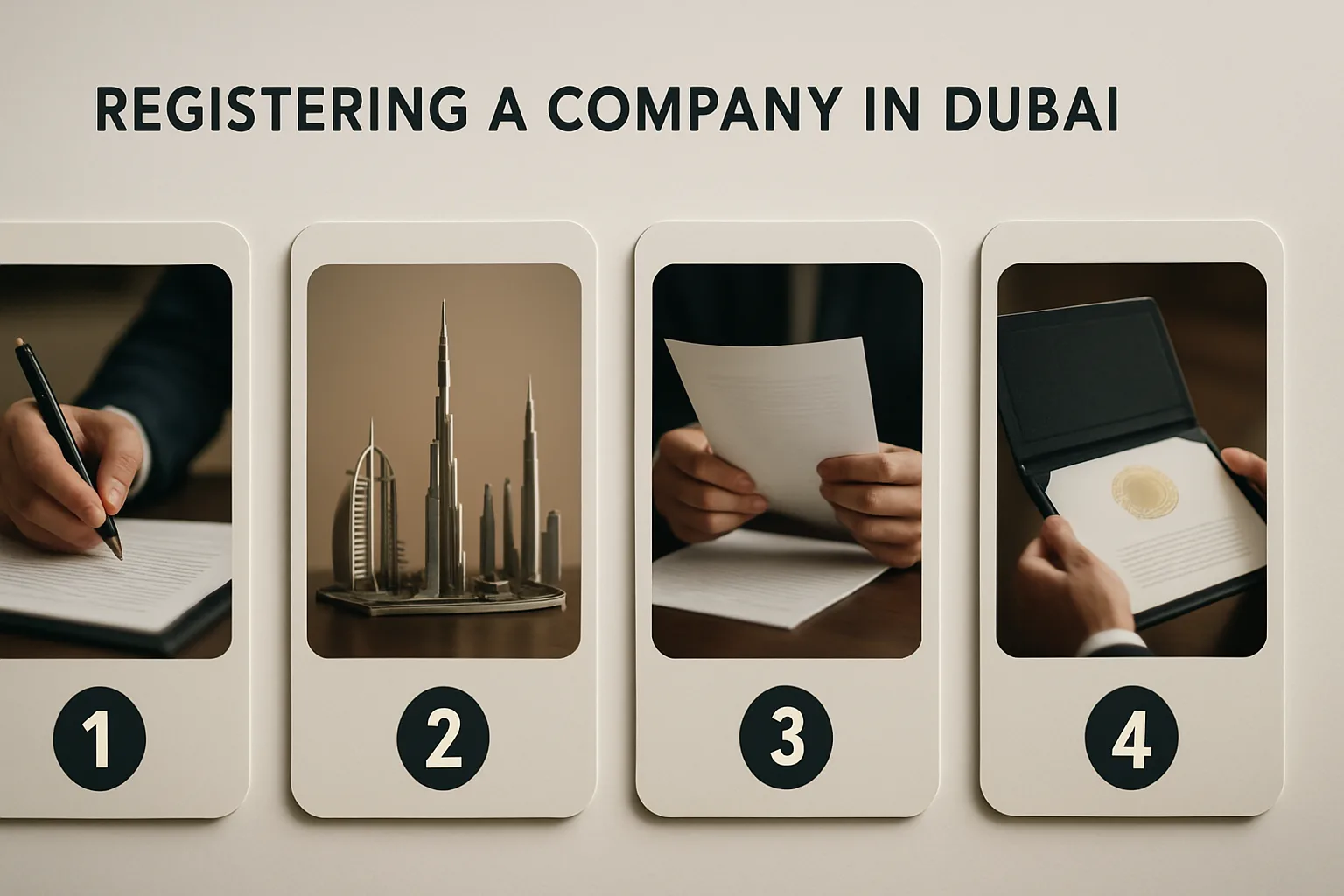
Step-by-Step: How to Register a Company in Dubai
The exact process varies by jurisdiction, but the main registration sequence is similar. A straightforward free zone consultancy can sometimes receive its licence quickly once all documents are ready. A mainland company with a physical office, multiple shareholders, regulated activities, or external approvals will usually take more coordination.
Before you begin, decide who the shareholders and manager or director will be, which activities you need, your trade name options, office requirements, visa needs, and expected annual budget. Doing this work upfront reduces rejected applications and avoids amendments to constitutional documents after incorporation.
- Define the business activity. Choose the activity or activities that accurately describe the company’s planned work. Check whether you need special approvals.
- Choose mainland or a free zone. Compare market access, office costs, visa allocation, customs requirements, and client locations before choosing an authority.
- Reserve a trade name. Submit proposed names that follow UAE naming rules. Avoid restricted terms, offensive language, and names that suggest government affiliation or regulated activities without approval.
- Apply for initial approval. The authority reviews the proposed shareholders, managers, activities, and ownership structure. Initial approval does not usually allow you to start operating yet.
- Prepare incorporation documents. These may include a Memorandum of Association, Articles of Association, board resolution, passport copies, UAE entry stamp or visa copies, proof of address, and ultimate beneficial owner information.
- Secure an office or flexi-desk. Mainland companies commonly need a registered tenancy arrangement. Free zones may offer desk, co-working, warehouse, or office packages.
- Submit documents and pay licence fees. The authority issues the trade licence once approvals, documents, and payments are complete.
- Complete immigration and visa establishment steps. Apply for an establishment card or immigration file where needed, then start investor and employee visa applications.
- Open a corporate bank account. Prepare a clear business plan, ownership documents, contracts or invoices where available, source-of-funds information, and proof of business operations.
- Set up compliance processes. Register for corporate tax and VAT where required, maintain accounting records, track beneficial ownership obligations, and note your licence renewal dates.
Here’s a practical example: a UK-based software consultant serving clients in Europe and the Gulf may choose a Dubai free zone professional licence with one investor visa and a flexi-desk. A company importing consumer goods for sale through Dubai retailers may need a mainland commercial licence, warehouse arrangements, customs registration, product approvals, and a more detailed operational setup.
Documents Required to Register a Dubai Company
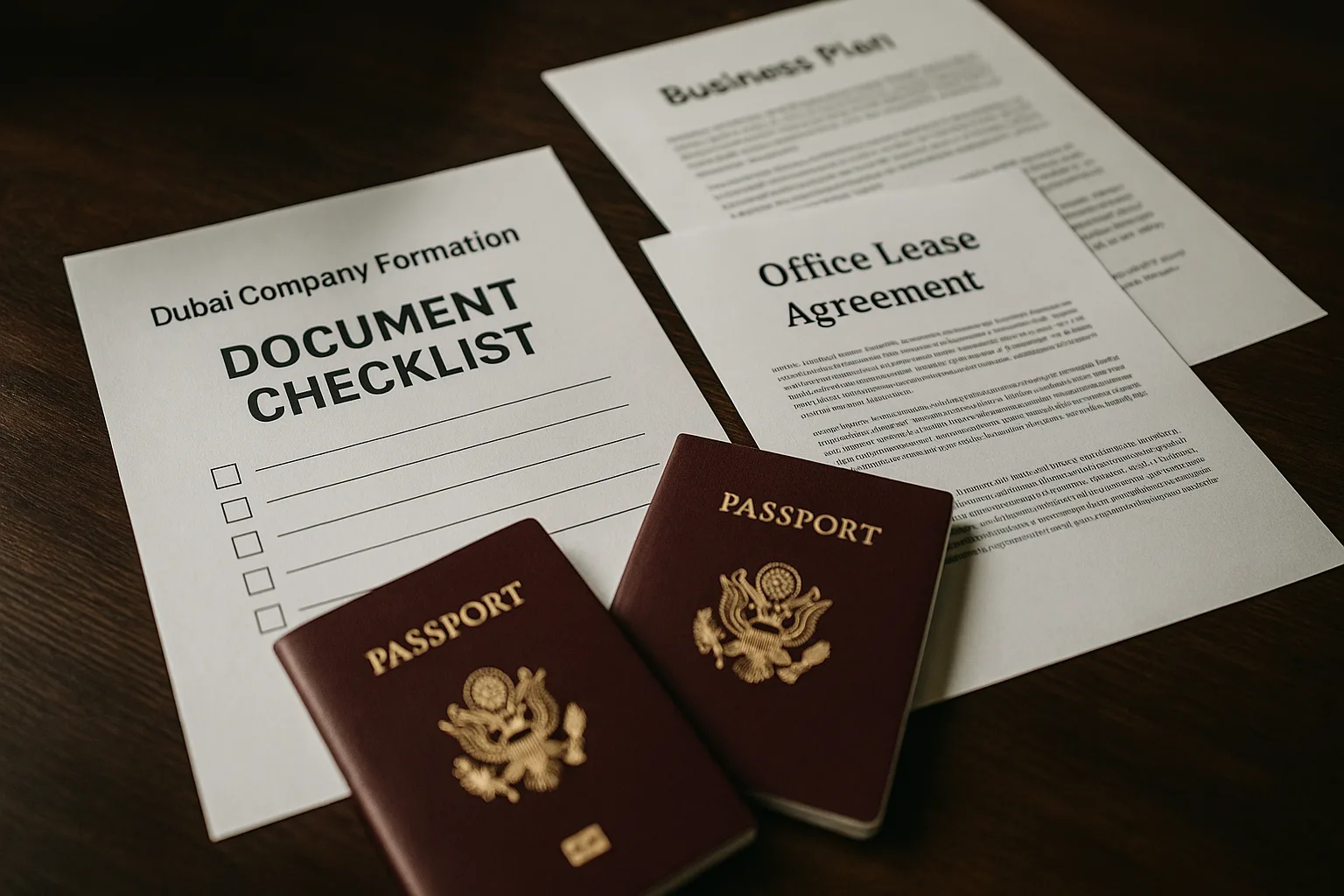
Most Dubai company registration applications require identity documents for every shareholder, director, manager, and ultimate beneficial owner. Corporate shareholders add another layer because the authority and bank will need to verify the ownership chain and confirm that the company is authorised to invest.
Document requirements vary by licensing authority, shareholder nationality, legal structure, business activity, and whether the shareholder is an individual or another company. Ask the chosen authority or a qualified corporate services adviser for an up-to-date checklist before notarising or legalising documents.
Typical Documents for Individual Shareholders
- Clear passport copy, usually with at least six months’ validity.
- Passport-size photograph meeting UAE visa standards.
- UAE visa and Emirates ID copy, if the shareholder is already a UAE resident.
- Proof of residential address, such as a recent utility bill or bank statement, where requested.
- CV, business profile, or business plan for certain free zones, regulated activities, or bank applications.
- Proposed company name and selected business activities.
- Details of the appointed manager or director.
Extra Documents for Corporate Shareholders
If a foreign company will own shares in the Dubai entity, authorities often ask for the parent company’s certificate of incorporation, constitutional documents, certificate of good standing where relevant, register of directors and shareholders, board resolution, and legalised power of attorney. Documents issued outside the UAE may need notarisation, attestation, and legalisation through the relevant UAE embassy or consulate, depending on the jurisdiction and the authority’s requirements.
Don’t assume the trade licence is the last document you need before you can operate. Landlords may ask for the licence and shareholder documents before signing a lease. Banks may request supplier agreements, customer contracts, invoices, website details, and evidence of the company’s commercial purpose before opening an account.
Dubai Company Registration Costs, Visas, Banking, and Tax Compliance
The cost to register a company in Dubai depends on the jurisdiction, activity, office solution, number of visas, shareholder structure, and government approvals. A basic free zone package may look affordable, but the first-year total can include licence fees, registration fees, establishment card charges, visa processing, medical testing, Emirates ID fees, health insurance, office rent, document attestation, and banking-related operating costs.
When planning your budget, separate one-time setup costs from recurring annual expenses. You’ll also need to account for bookkeeping, tax registration, licence renewal, visa renewals, office renewal, and sector-specific compliance. Prices change regularly, so get a written quotation that clearly shows what is included and excluded.
| Cost Category | What It May Include | Planning Consideration |
|---|---|---|
| Trade licence and registration | Authority fees, name reservation, incorporation documents | Usually renewed annually |
| Office or flexi-desk | Desk package, serviced office, warehouse, Ejari tenancy | Often affects visa eligibility |
| Investor and employee visas | Entry permit, status change, medical test, Emirates ID, residence visa | Costs vary by visa type and duration |
| Professional services | Accounting, audit, legalisation, tax advice, corporate services | Useful for complex structures and regulated activities |
| Banking and operations | Minimum balance requirements, payment gateway, insurance, bookkeeping | Bank onboarding can take longer than licence issuance |

Corporate Tax and VAT After Incorporation
Every UAE business should review its corporate tax obligations soon after formation. Corporate tax registration, filing deadlines, qualifying free zone income conditions, deductible expenses, transfer pricing rules, and small business relief eligibility can be technical. A free zone licence does not automatically make all company income taxable at 0%.
VAT registration becomes mandatory once you meet the taxable turnover threshold. Businesses below the mandatory threshold may qualify for voluntary registration when taxable supplies, expenses, or imports meet the relevant threshold. Good bookkeeping from day one makes tax registration, returns, audits, and bank reviews much easier.
Opening a Dubai Corporate Bank Account
A trade licence does not guarantee immediate bank approval. UAE banks carry out due diligence under anti-money laundering and know-your-customer rules. They want to know who owns the company, how it earns money, where funds come from, which countries it trades with, and whether its activity matches the licence.
Prepare a concise company profile, business plan, signed contracts, invoices, supplier details, website, financial projections, proof of address, and shareholder source-of-wealth documents where relevant. Incomplete or inconsistent information is a common reason bank applications get delayed.
Common Dubai Company Registration Mistakes to Avoid
The biggest formation mistakes often happen before you file the application. Entrepreneurs sometimes pick a jurisdiction based only on a promotional licence price, then find out that the licence does not support their sales model, visa plan, warehouse needs, or banking expectations.
Your structure should match the real business. Don’t build it around assumptions that a free zone company can automatically trade anywhere in the UAE, that corporate tax never applies, or that a bank will approve an account without evidence of genuine business activity.
- Choosing the cheapest licence rather than the right activity. A lower setup cost can be wiped out by later amendments, new approvals, or a second entity.
- Ignoring office and visa capacity. Check how many visas the selected package supports and what upgrades will cost as your team grows.
- Using a trade name that creates approval issues. Names involving religion, government bodies, financial services, or famous brands can be rejected or need consent.
- Failing to plan for banking compliance. Build a documented business case before applying for a corporate account.
- Misunderstanding free zone tax treatment. Review UAE corporate tax rules and qualifying free zone person conditions with a tax professional.
- Delaying bookkeeping. Poor records can create tax, visa, banking, investor, and due-diligence problems later.
- Using generic documents for regulated activities. Healthcare, education, finance, real estate, food, and transport businesses often need tailored approvals.
Before you commit, request a written scope of work from the formation provider or authority. It should list the activity code, jurisdiction, legal structure, licence validity, number of included visas, office type, government fees, estimated renewal costs, and exclusions such as bank account support, medical testing, tax registration, or document legalisation.
Frequently Asked Questions
How much does it cost to register a company in Dubai?
Dubai company registration costs vary widely. Your final cost depends on the licence activity, mainland or free zone jurisdiction, office arrangement, visa requirements, and government approvals. A basic free zone package may cost less than a mainland setup with a leased office and several visas, but you should also budget for renewals, immigration costs, accounting, tax compliance, and banking requirements.
Can a foreigner own 100% of a company in Dubai?
Yes, foreigners can own 100% of many Dubai mainland and free zone companies. Some activities are still subject to separate regulations, professional licensing conditions, or sector authority approvals. Check ownership eligibility against the exact activity code before incorporation.
How long does it take to register a company in Dubai?
A straightforward company registration can be completed quickly once documents, name approval, activity selection, and payment are in place. The full timeline may be longer if you need a physical office, external approvals, legalised corporate shareholder documents, investor visas, or corporate bank account onboarding.
Do I need to live in Dubai to start a company there?
No, many entrepreneurs can start the company formation process from outside the UAE, particularly for simple free zone structures. But shareholders may need to visit the UAE for visa medical testing, Emirates ID biometrics, bank meetings, or certain document-signing requirements.
Do Dubai free zone companies pay corporate tax?
Free zone companies fall within the UAE corporate tax framework and must assess their registration, filing, and tax obligations. A qualifying free zone person may be eligible for a 0% rate on qualifying income, but this is not automatic. The company must meet detailed legal conditions, keep adequate records, and avoid disqualifying activities or income.
Conclusion / Final Thoughts
To register a company in Dubai successfully, begin with the commercial reality of your business: where your customers are, what you will sell, whether you need UAE market access, how many visas you need, and what evidence a bank will expect. Then choose the jurisdiction and licence activity that support those needs instead of focusing only on the headline setup price.
Create a written formation plan before applying. Include your preferred legal structure, activity codes, shareholder documents, office model, first-year budget, visa timeline, bank account strategy, and tax compliance responsibilities. That plan will help you secure the right Dubai trade licence, avoid expensive amendments, and launch a company that is ready to operate legally from day one.